
How to choose a kitchen backsplash tile
How to pick a kitchen backsplash tile: ceramic, porcelain, glass and mosaic compared, plus grout, how high to run it, and how much tile to order.
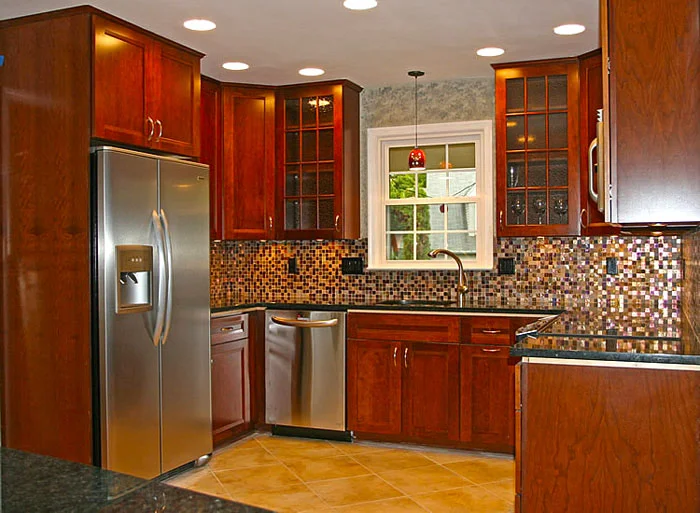
Start with the counter and cabinets, because the backsplash has to live with them. Then pick the material by how you cook and clean. Then, before anything goes on the wall, check the tile in your own kitchen light.
The goal is a wall that looks the way you pictured it. This guide covers four tile types, ceramic, porcelain, glass and mosaic, along with the details that decide how they turn out: the color of the mortar, the grout, where the tile stops and how much to order.
We do backsplash installation, often as part of a kitchen remodel, so we have a stake in this. Each point below names its source, so you can read it yourself. Many of those sources are tile sellers and makers, so where one is selling something, we say what kind of company it is.
Start with what is already in the kitchen
KraftMaid, a cabinet maker, says that to blend a backsplash in, take color cues from your countertops, your cabinets or both. Tile Mart, a tile retailer, says to aim for tones that work together, and not an exact match.
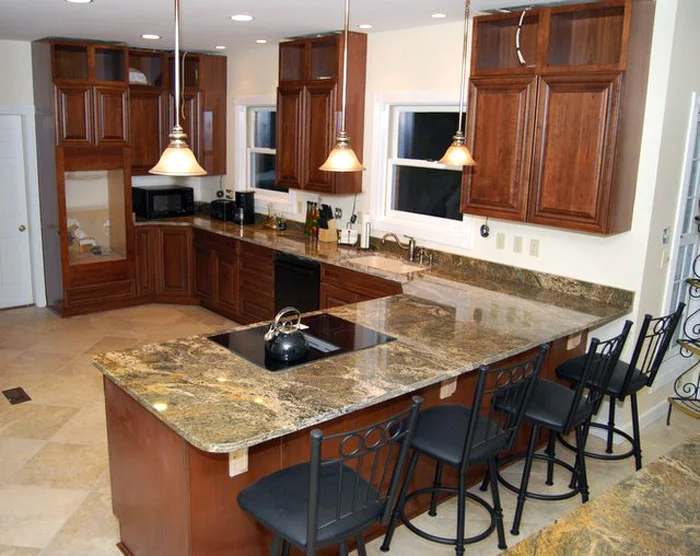
A useful way to think about it is to decide which one thing in the room should stand out. If your counter has strong veining, a quiet tile lets it lead. If your counter and cabinets are plain, the backsplash can be the part people notice.
If you are replacing counters too, Centura suggests choosing the cabinets and countertop first.
The four tile types
Ceramic
Ceramic is the familiar choice. Tile Mart calls it easy to cut and install. Centura, a Canadian tile company, says ceramic, glass and porcelain are not porous, so dirt stays on the surface.
Porcelain
Tile Mart describes porcelain as denser and less porous than ceramic, and it presents porcelain as the tougher choice. Between the two, let the look you want lead.
Glass
KraftMaid says glass tiles are easy to wipe clean. Tile Mart adds that glass can show fingerprints and water spots more than a matte surface, and suggests a satin or frosted finish if that would bother you.
Glass also has the most ways to go wrong during installation, so it gets its own section below.
Mosaic
A mosaic is many small pieces, usually sold on a sheet. It can be glass, stone, ceramic or a mix. More small pieces mean more grout lines, so the grout color becomes part of the look. Tile Mart says large format tile means fewer grout lines, and that is the trade to think about.
If the mosaic has natural stone in it, it needs more care. KraftMaid says stone is porous and must be sealed and resealed to resist stains. Bedrosians, a tile maker, says to use a penetrating sealer before grouting matte glass or mosaics with natural stone.
Subway tile, and peel and stick
Subway tile is a shape, not a material. MSI says makers use the name for any rectangle roughly twice as long as it is tall, and Daltile says the classic one is a white 3 by 6 inch glazed ceramic tile. It now comes in glass, porcelain and stone too, so it falls under the backsplash tile we install.
Peel and stick is the shortcut people ask about. Bob Vila says some can last 3 to 5 years or longer, but that they do not give the same waterproof protection as tile, and that ones that are not heat resistant may peel near heat. It suits a quick refresh. For a backsplash meant to last, tile is the one built for water and heat.
Why glass tile can look wrong on the wall
Most guides we read say little about this. Glass is see-through to some degree, so what sits behind it shows.
Oceanside Glass & Tile, a glass tile maker, says the color of the thin-set will affect how the installed tile looks. Thin-set is the mortar that holds the tile to the wall. It recommends specific white thin-sets, and it notes that even these vary in whiteness. Bedrosians says white mortar is commonly recommended, and that color consistency and full mortar coverage are essential, especially with translucent tile. It also says to avoid mixing setting materials from different production batches.
Here is what that means for you. Ask what mortar will go behind your glass tile, and ask to see a test piece set in it. The tile in the box and the tile on the wall can be different colors.
Glass also moves more than other tile. Bedrosians says it has a high rate of expansion and contraction, and it recommends silicone caulk wherever the glass meets a change of plane, such as a corner. It also calls for a grout joint of at least 1/16 of an inch. A glass backsplash set tight with no joint at all does not meet that guide.
Grout: makers do not all agree
Grout gets chosen last, and it can change the whole look.
For tight joints, MSI, a surfaces company, says unsanded grout works best at 1/8 of an inch or smaller, and sanded performs best on joints wider than that. It says unsanded is usually preferred on vertical surfaces such as a kitchen backsplash.
Glass is where the advice splits. MSI says glass can be scratched by sanded grout. Bedrosians says non-sanded grout is highly recommended to prevent scratching. But Oceanside says sanded cement grouts are compatible with its products and will not scratch them.
Those are three companies giving different answers about different tile. The way through is simple: follow the installation sheet from the maker of the tile you bought. If you want to see the sheet, ask.
Then there is staining. Tile Mart says cement grout needs sealing to resist stains and moisture, and epoxy grout costs more but does not need sealing. We looked for a maker’s rule on which grout belongs behind a stove, and we did not find one we could read. What we found was conflicting advice, so we are not giving you a rule here. Ask what the maker of your grout says about heat and grease.
How high to run it, and where to stop
Tile Mart says most backsplashes cover the space between the counter and the upper cabinets, usually 15 to 18 inches. KraftMaid suggests going further for a richer look, carrying tile all the way to the ceiling on either side of the sink or behind a vent hood. Avalon Flooring, a retailer, says there are no real set rules for how high it goes.
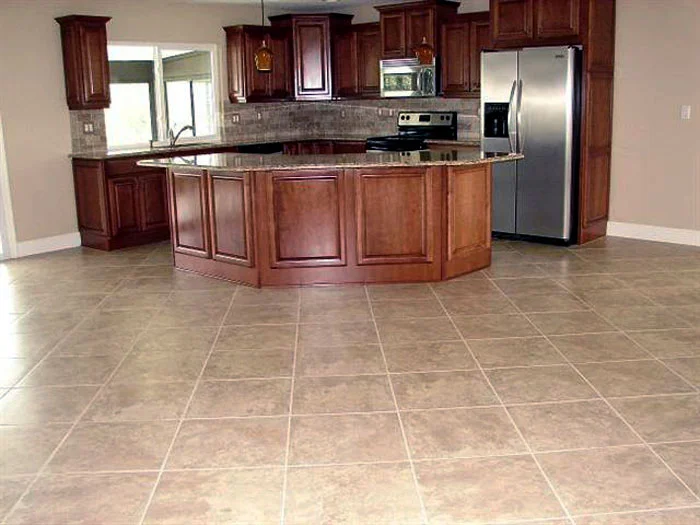
So height is your call. What takes more thought is where the tile ends, because the end of a backsplash is where people look. None of the guides we read treats this as a design choice. Before the first tile goes up, walk the wall with your installer and ask:
- Where does the tile stop on the open side, if the wall runs past the cabinets?
- What finishes the raw edge, a trim piece or a finished tile edge?
- How will the tile meet each outlet and switch plate?
- What happens at the window, if there is one over the sink?
- Where will cuts land, and can the layout hide the small ones?
Tile Club, a tile seller, says edge finishing is one of the details to settle before the first tile is set. Some installers include edge trim in their estimate and some do not, so ask.
See it in your own kitchen first
Tile looks different in a store. Tile Mart says to look at samples in the morning, afternoon and evening light. Avalon says samples are a must, and to check them against your counters, cabinets and appliances under your kitchen lights.
Do this with more than one piece if you can. Oceanside says variation in color, shade, tone and size is normal in its handmade glass tile. A single sample cannot show you that range, so ask how much the tile varies.
Check the boxes before the install
Two makers put real weight on this step. Bedrosians says the installer must lay the tile out dry, under proper lighting, before installation, and that the end user should inspect it. Its guide says that once the tile is installed, it is deemed accepted. It also says to mix tiles from several boxes to spread the color range evenly.
Oceanside says the owner should approve the first five square feet of installed tile before the installer goes on, and that it will make no adjustments after installation.
Other makers may have different terms, so read the sheet for yours. But the habit works for any tile. Look at it laid out, before it is stuck to your wall, while a change is still easy.
How much tile to order
Order more than the wall measures. Three sources line up closely:
- Tile Mart says to add 10 to 15 percent to your measured square footage.
- Tile Club says 10 to 15% is often suggested, and that your installer is the best source for the exact amount.
- KraftMaid says 10% for simple grid patterns and 15 to 20% for more complex shapes and patterns.
Tile Club lists cuts, breakage, pattern alignment and future repairs as reasons for the extra. Keep what is left. If a tile ever cracks, you will want one from the same order, not a near match.
How to choose
Choose plain ceramic or porcelain if:
- You want an easy tile to live with and plenty of color and size choices.
- You want fewer grout lines, using a larger tile.
Choose glass if:
- You like the color once it is set in mortar, on a test piece.
- You are fine wiping off fingerprints and water spots, or you choose a satin finish.
Choose mosaic if:
- You want more pattern on the wall, and you like the grout color as part of it.
- You will keep up with sealing, if it contains natural stone.
What to ask before you order
- What does the tile maker’s installation sheet say about mortar and grout?
- Can I see a test piece set in that mortar, with that grout?
- Will you lay the tile out for me to look at before it goes on the wall?
- How much extra should I order for this pattern and this wall?
- How will you finish the edges, and is that in the estimate?
Picked a backsplash tile, or stuck between two? Tell us about your kitchen.
Where we work
Kitchens across Pasco, Pinellas and Hillsborough get their backsplashes from us, and we work out of Odessa, in Pasco County. Tell us about your counters and cabinets, what the wall looks like now, and the look you have in mind.
About the author
Andy's crew sets the backsplashes this guide describes. Andy Tsiouklas is the owner of Trinity Tile and Stone. In Andy's words: "My father has been in the construction field all his life, and I ended up going the same route he did, keeping it in the family."
Related work
A backsplash is tile work, and it can be one part of a kitchen job.