
Flooring for Seniors: Safer Floors for Older Homeowners
What a floor can do about slips and trips for older homeowners: slip ratings, thresholds, wet rooms and rugs, with CDC and TCNA sources you can check.
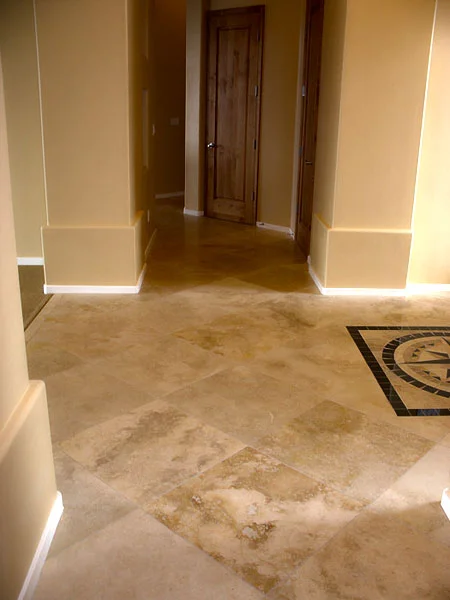
A floor cannot stop a fall. What it can do is take away some of the things people slip on and trip over: a raised edge, a wet and shiny surface, a loose rug. Most of that comes down to three choices: how the floor grips when wet, where one floor meets another, and what you lay on top of it.
The numbers explain why people ask. The CDC says over 14 million, or 1 in 4 older adults, report falling every year. It calls falls the leading cause of injury for adults 65 and older. So this is a fair thing to plan around when you pick a floor, whether it is for you or for a parent.
We install floors, so we are not a neutral party. We have kept the claims below to what the CDC, the Tile Council of North America and the federal Access Board actually say, and we link each one so you can read it yourself. We left prices out, because a price depends on your rooms.
What a floor can and cannot do
Falls have many causes, and the floor is only one of them. The CDC’s fall prevention page starts with the person, not the house. It tells older adults to ask a doctor to evaluate their risk, to have a doctor or pharmacist review medicines for anything that causes dizziness or sleepiness, to do exercises that build leg strength and balance, and to see an eye doctor at least once a year.
Then it turns to the home. Its list is short: get rid of things you could trip over, add grab bars in and near the tub, shower and toilet, put railings on both sides of stairs, and add more or brighter light bulbs.
Notice what is on that list and what is not. Only one of the four items is about the floor, and it is about things lying on it. None says “buy this kind of flooring.” So be careful with anyone who promises a fall proof floor, because the CDC does not offer one.
So here is the honest job description. A good floor lowers the chances that the surface itself causes a problem. The rest is balance, eyesight, medicines, lighting and habits.
Slip resistance: what the number means
If you shop for non slip flooring, you will meet a number called DCOF. It stands for dynamic coefficient of friction. The standard that governs it, ANSI A326.3, defines it as the ratio of the force needed to keep one surface sliding over another. That is a lab measure of grip.
The Tile Council of North America (TCNA) publishes the page that lists the value most people quote. For interior floors that will be walked on when wet, it shows a wet DCOF of at least 0.42, or a value the manufacturer declares.
Here is the part that matters, and most shopping guides skip it. The same TCNA page says DCOF does not predict the likelihood a person will or will not slip on a surface. It also says the measured value should not be the only factor in deciding whether a flooring material is right for a place.
So a tile with a good number is a better starting point, and not a promise. Ask for the number for the exact tile, not the product line. Ask whether it is a wet number. Then look at how the room will really be used.
Dirt, soap and wear change the grip
TCNA’s page lists “dirt, water, soap, oil, or grease” as contaminants that can change the DCOF. It also says the value depends partly on how the floor is used and maintained, and it tells specifiers to think about expected contaminants, maintenance and wear.
In a house, that has plain meaning. A bathroom floor with soap film and a kitchen floor with cooking oil behave differently from the clean sample in a showroom. We would rather you plan for how you really live than for the sample.
Trips: where one floor meets the next
For many older homeowners, the bigger risk is not the slick spot. It is the edge. A threshold between rooms, a step down to a lanai, a lip where tile meets carpet: these are places where a foot catches.
The CDC’s advice is blunt: remove things you could trip over. A raised transition strip is a thing you could trip over, and it sits in the floor, so you cannot move it like a rug.
There is a useful yardstick here. The federal Access Board’s ADA Standards cover public buildings and accessible routes, and they do not govern your living room. Still, they show how small a change in level has to be before it counts as something to manage. Under the standards, a vertical change of one quarter inch is permitted. Between one quarter and one half inch it must be beveled. Above one half inch it must be ramped.
Those numbers come from a rulebook for wheelchair and mobility device access, so use them as a yardstick, not a code for your house. But they show how small these edges are. A one half inch lip does not look like much on a plan. Under a shuffling foot or a walker wheel, it matters.
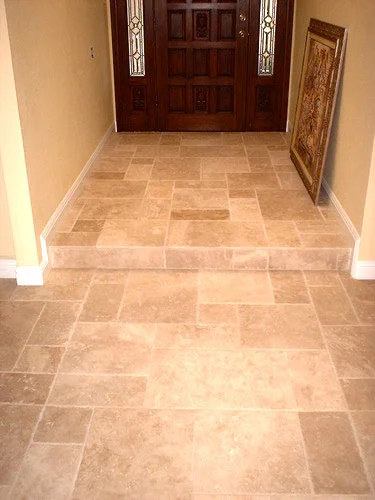
What to ask about transitions
When we look at a floor change, these are the questions worth asking:
- Where does the new floor meet the old one, and how high is each?
- Can the two floors sit at the same height, so no strip is needed?
- If a strip is needed, can it be low, and can it be fastened flat?
- Is there a step at the entry or the lanai door that could be changed or marked?
Same height is the best answer. Whether it is possible depends on what is under the floor and how thick the new floor is. That is a reason to measure before you choose, and it is part of how we look at a flooring installation.
Wet rooms: bathrooms and showers
The bathroom is where the two problems meet. It is wet, so slipping matters, and it often has edges, like a tub rim, a shower curb and a door threshold.
The CDC says to add grab bars inside and outside your tub or shower and next to the toilet. That is not a flooring item, but it belongs in the same conversation. A grip surface on the floor is a backup. A bar you can hold is the main safeguard.
On the floor itself, go back to the DCOF discussion. TCNA’s page lists categories, and the one for floors walked on when wet is its own line. Ask the manufacturer for a wet DCOF on the tile you like, and whether it is a measured number or a declared one. If a seller cannot tell you, that is useful information too.
TCNA also says coated materials should only be used in areas that can be kept dry, unless the coating’s manufacturer says otherwise. Bathrooms are wet areas, so that is a fair thing to ask about any glazed or coated product.
If you are thinking of a tile shower, our shower work starts with the same questions. We do not claim a shower can be made fall proof. We can help you choose tile with a stated wet number and talk through where the floor edges will fall.
Grout lines
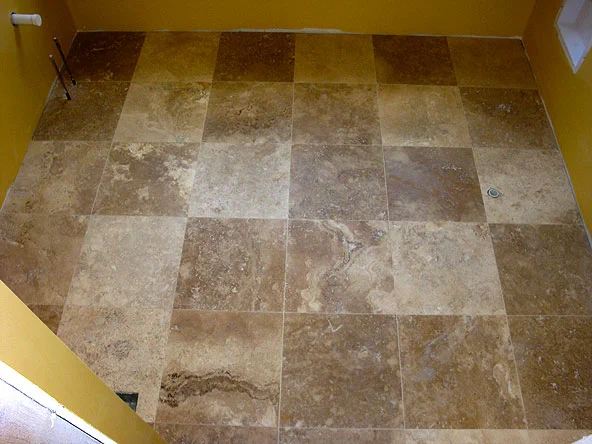
Small tile means more grout lines, and TCNA says DCOF depends partly on how the floor surface is structured. We have not found a source that gives one rule for tile size and grip, so we will not give you one either. What we can say is that a larger tile with a stated wet number and a smaller tile with a stated wet number are both worth a look. Ask to see them side by side, and walk on a sample if the showroom has one.
Soft floors, rugs and what you lay on top
Carpet, rugs and mats sit right where feet go, and they are easy to change.
Start with the CDC’s line again: remove things you could trip over. A loose throw rug, a curled mat or a cord across a hall is that thing. If you want a rug, think about whether it needs to be there at all.
When carpet goes in, the Access Board’s standards give a checklist of what a safe edge looks like. Carpet should be securely attached, with a firm cushion or no cushion, a pile height of one half inch at most, and exposed edges fastened down with trim along the whole length. Again, that is the rule for public accessible routes, so it is a yardstick and not a home code. But “firm, attached, low” is a good thing to want in a house.
We install carpet as well as tile, and luxury vinyl plank. For vinyl plank or any other floor besides tile, ask the maker what slip test they used and what the result was. We would not take a guess in place of that answer.
Walk your home, room by room
Walk through your house, or your parent’s, with this list. It takes about as long as a cup of coffee. Each line names the room and the one thing to look at.
- Front door: look for a step or a raised sill, and whether anything on the floor could catch a toe.
- Hallways: check that every rug lies flat, and that no cord crosses the path.
- Kitchen: stand where you cook and look at the floor there, because oil and water land in the same spot.
- Bathroom: note every edge, from the door sill to the tub rim, and whether there are grab bars where you reach.
- Shower: ask how the floor grips when wet, and what you hold as you step in.
- Bedroom: look at the path from the bed to the bathroom in low light.
- Stairs: see whether there is a railing on both sides, and whether each step edge is easy to see.
- Lanai or back door: find the step or lip going outside, and whether it is lit.
- Where floors meet: check that each join is level, which is part of our flooring installation and tile installation work.
The trip, railing and lighting items echo the CDC’s home safety advice. The rest are the places we would look first.
What to ask before you pick a floor
Bring this to any showroom, ours or another, and ask it of any installer:
- What is the wet DCOF of this exact tile, and is it measured or declared by the maker?
- What does the maker say about using it in a bathroom or a shower?
- Where will the new floor meet the old one, and at what height?
- Can the transition be level, or as low as possible?
- How will soap and cleaning products affect the grip of the floor in a wet room?
- What would you change at the door to the lanai?
Good answers are specific. A vague answer is a sign to keep asking.
If you are in Odessa, or anywhere in Pasco, Pinellas or Hillsborough, we are happy to look at the rooms with you. Floors are one piece of a safer home. They are a piece we can help with, and we will tell you plainly what a floor can and cannot do.
Want a floor that is easier on you or your parents? Tell us about the rooms.
Where we work
We work out of Odessa, in Pasco County, and take flooring jobs across Pasco, Pinellas and Hillsborough. Tell us which rooms worry you and what is on the floor now.
About the author
Andy's crew installs tile, wood, carpet and vinyl plank floors. Andy Tsiouklas is the owner of Trinity Tile and Stone. In Andy's words: "My father has been in the construction field all his life, and I ended up going the same route he did, keeping it in the family."
Related work
These are the floors we install, and each page says more about the work.