
Shower Tile Ideas for a Florida Home
Shower tile ideas that work: six laying patterns, which tile sizes suit walls and floors, how to pick grout, and what to ask before you choose.
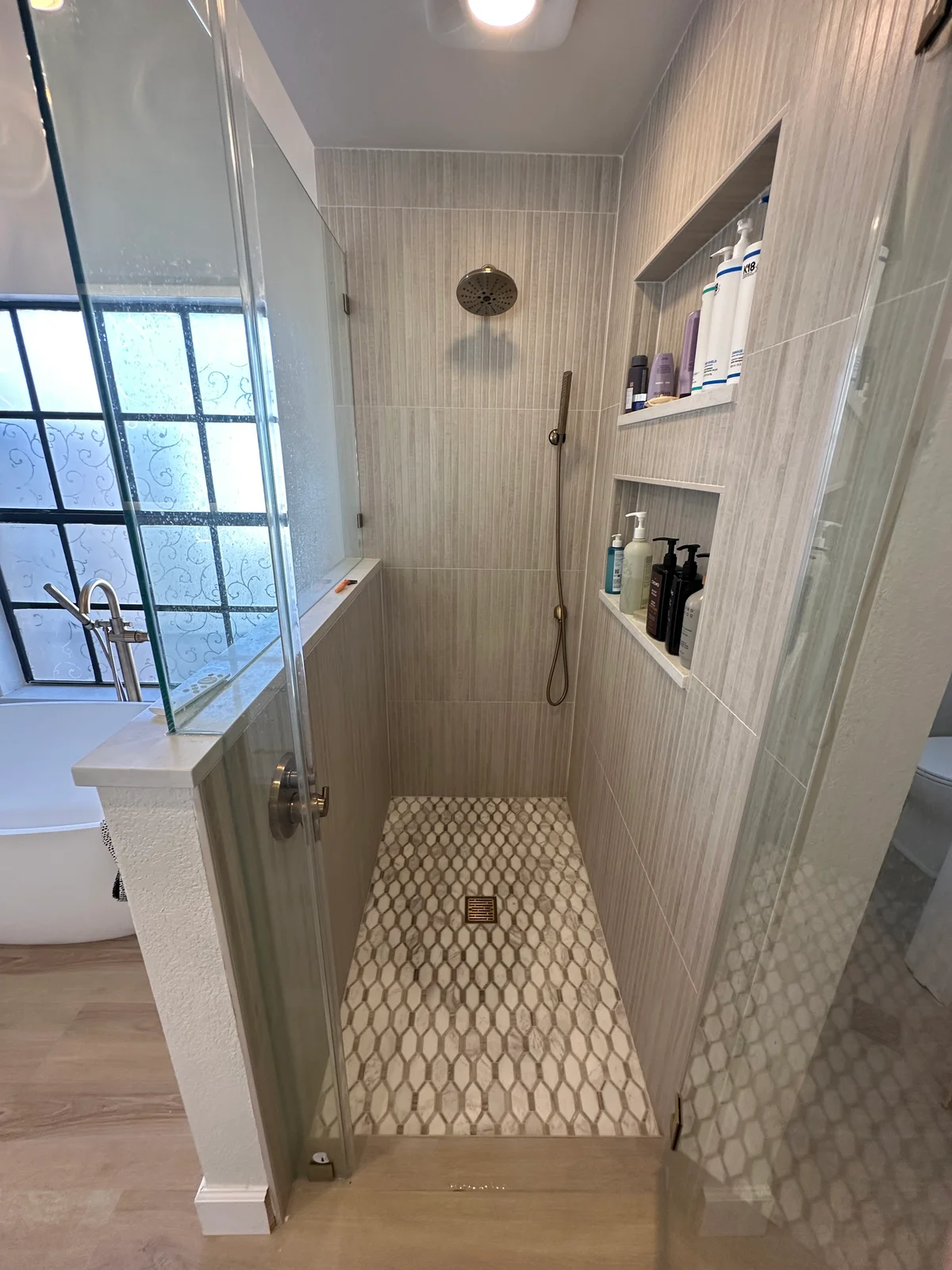
Good shower tile comes down to three choices that work together: how the tile is laid, how big it is, and what color the grout is. Settle those and most of the rest follows. Below are six laying patterns, which sizes suit walls and which suit the floor, and what to ask before anyone sets a tile.
We build tile showers as part of our shower work, and our own crew does the installation, so we are not a neutral party. Every outside fact below links to the page we read. We left prices out, because a price depends on your bathroom and the tile you pick.
Six ways to lay shower tile
The pattern changes how a shower feels before color does. These drawings are simple sketches, not to scale. The same tile can look calm or busy depending on how it is laid.
Stacked
Joints line up in straight rows and columns. Bob Vila calls it a cinch to install, often with no tile cutting. We think straight lines leave nowhere to hide a crooked tile.
Offset
Each row slides over half a tile, like brick. Bob Vila describes it as a 50 percent offset and says the short side of a tile marks the halfway point. It is the familiar choice.
One third offset
Each row slides over a third of a tile, which makes soft diagonal steps. Bob Vila says it suits tiles 18 inches or longer because it resists lippage, the small height step between two tiles.
Vertical stack
Tiles stand on end in straight columns. Bob Vila says it suits low ceilings and enclosed areas because it gives an impression of height. A shower is an enclosed area.
Herringbone
Rectangles meet at right angles in a zigzag. Bob Vila says a 2 to 1 tile reads as a quiet wave and a 4 to 1 tile makes sharper zigzags. The drawing is the straight version.
Basket weave
Pairs of tiles run side by side, then turn. Bob Vila says stronger contrast between tile and grout makes the weave stand out. In our view it is best on one wall, not all four.
Notice what the sketches have in common. Every pattern is made of the same rectangles. Only the way they meet changes.
Start with the room, not the picture. If your shower is small or the ceiling is low, the vertical choices earn a look. Bob Vila says a vertical offset is ideal for small enclosures and adds a sense of height. Save the busier patterns, like a turned herringbone, for small areas. The guide calls that one of the most painstaking patterns to install, so it is worth asking whether your installer has laid it before.
The shower at the top of this page does something different. It mixes tile sizes instead of repeating one size, so the wall has no repeating rows. That is a pattern too. In our view it asks the person setting the tile to plan where each piece goes.
Big tile on the walls, small tile on the floor
Most showers pair two sizes, and there is a reason. A shower floor has to slope. The Ceramic Tile Education Foundation says a stall shower floor should slope one quarter inch per foot toward the drain, per plumbing code, with no low spots that could hold water. The walls are flat, so large tile is an option there.
That slope is also why floor tile deserves its own decision. If you want large tile on the floor, ask which drain makes it work. Schluter, a maker of shower systems, lists a linear drain that accommodates single plane slope and large format tile. Ask your installer how your floor will be sloped before you fall for a tile size.
On the walls, bigger tile means fewer joints. In our view that is easier to look at and easier to keep clean. Tile that is long as well as big brings the lippage point back. Bob Vila’s guide says the one third offset suits tiles 18 inches or longer for that reason. If you love a long tile, ask the installer which offset they would use and why.
For our tile installation work, we help you pick the tile and then our crew sets it. Bring a photo of the shower you are picturing and we can talk about what each size asks for.
Grout is half of the look
Grout fills the lines between tile, so the pattern you chose is drawn in grout color. A grout that matches the tile makes the pattern soften. A grout in a different shade draws it out. The same Bob Vila guide says contrast makes a basket weave stand out, and suggests white tile with dark grout to make a room look taller.
There is also a plain rule about the kind of grout. Bob Vila says unsanded grout is made for joints an eighth of an inch or less, and sanded grout suits joints from an eighth to half an inch. It also says sanded grout is more likely to slump, crack or leave gaps in narrow lines. So the width of your joint decides the kind of grout, and the kind of grout should be settled before the tile goes up.
Then there is cement or epoxy. Fine Homebuilding says epoxy grout resists stains and chemicals, and that joints grouted with epoxy do not need a sealer, while cement grout does. It also says epoxy is harder to work with: hard epoxy residue is difficult to remove, and cement grout is more forgiving. That article is from 2007, so formulas may have changed, but the trade-off still matters. Ask which one your installer plans to use, and whether the shower needs a sealer.
Can mold grow behind the tile? It can, if water gets past it. Schluter, which makes shower waterproofing, says tile and grout are not waterproof on their own, and that water seeping through the grout lines can lead to rot and mold. Custom Building Products says to seal cement grout, even when the tile is glazed. So the real protection is the waterproofing behind the tile, with sealed grout as the first line in front of it.
Check the grip on the floor
A pretty shower floor still has to be safe to stand on with wet feet. Tile makers rate this with a number called wet DCOF. Crossville, a tile maker, says a wet DCOF of 0.42 or greater is the industry standard for tile suited to level interior spaces that people walk on when wet. It adds that the method for measuring it is ANSI A326.3, developed by the Tile Council of North America.
Read the fine print on that page. It says a tile with that number is not necessarily suitable for every project, and that the number should not be the only thing you rely on. The benchmark is also for level floors, and a shower floor slopes. So treat the number as a place to start. The same page lists what else to weigh: the type of use, the expected contaminants, maintenance and wear. Soap and shampoo are contaminants in a shower, so say so out loud when you choose. Ask the maker, or ask us, how the tile you like is meant to be used.
Natural stone in a shower
Stone is a popular shower idea, and it has its own questions. The Natural Stone Institute, the stone trade’s association, says many marbles are well suited for wet areas, including tub decks and showers. It also says marble’s calcite is vulnerable to mild acids, and that you should accept the care and the patina that come with it.
That second point is worth reading twice. Marble can change where an acid touches it. If you are leaning toward stone, ask what cleaners are safe for it before you buy, not after. We did not find a sealing schedule on the Institute’s page, so we will not give you one. Ask the person installing the stone what they use and how often it should be redone.
We work with travertine and marble too. Whatever stone you like, ask to hold more than one sample piece, and ask to see it wet. A picture will not tell you how it looks under a shower head.
Niches, bands and accents
An accent is a small place to be bold. A niche, the recessed shelf for shampoo, can be tiled in a different tile from the wall. A band of small mosaic running through plain wall tile does the same job across a whole wall.
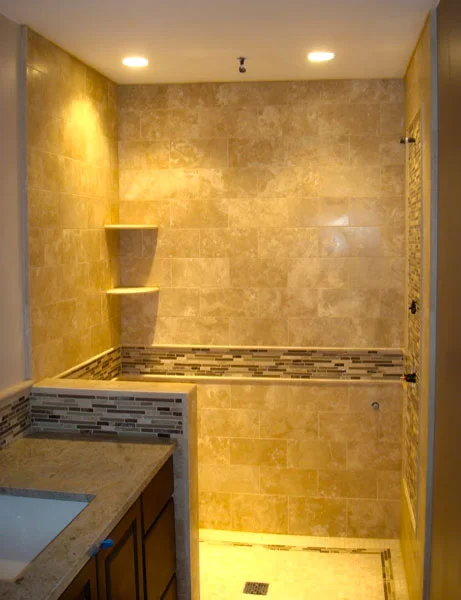
The niche is also where the part you cannot see matters most. Schluter says tiles are not inherently waterproof and must be installed with a waterproofing system. It sells a prefabricated niche made of its KERDI-BOARD. You do not need that brand. You do need an answer to this question: what is behind the tile, and how is the inside of the niche waterproofed?
That is the question we like homeowners to ask, because the answer says more about the job than the tile does. Our showers page talks about the same worry, and so does our page on bathroom remodeling.
What to ask before you choose
Put the pieces together and you have a short list. Take it to any installer, us included.
- Which pattern will you lay, and where will the joints fall on my walls?
- What size tile on the walls, and what size on the floor?
- How will the floor be sloped to the drain, and which drain do you use?
- Sanded or unsanded grout, cement or epoxy, and what color?
- If it is stone, what cleaners are safe, and what do you seal it with?
- What is behind the tile, and how is the niche waterproofed?
If a shower is on your mind, come see tile in person at our showroom in Odessa, or bring photos. We help you pick the products, and our own crew does the work.
Picturing a tile shower? Tell us about your bathroom and we will talk it through.
Where we work
We set tile from our base in Odessa, in Pasco County, and work across Pasco, Pinellas and Hillsborough. Tell us about your shower and the tile you are weighing.
About the author
Andy's crew sets tile in showers, in house. Andy Tsiouklas is the owner of Trinity Tile and Stone. In Andy's words: "My father has been in the construction field all his life, and I ended up going the same route he did, keeping it in the family."
Related work
Shower walls, floors and the rest of the bathroom each have a page of their own.