
LVP vs Laminate: Vinyl Plank or Laminate for Your Home
Vinyl plank and laminate look alike but are built differently. See how each handles water, feels underfoot and what goes under it, room by room.
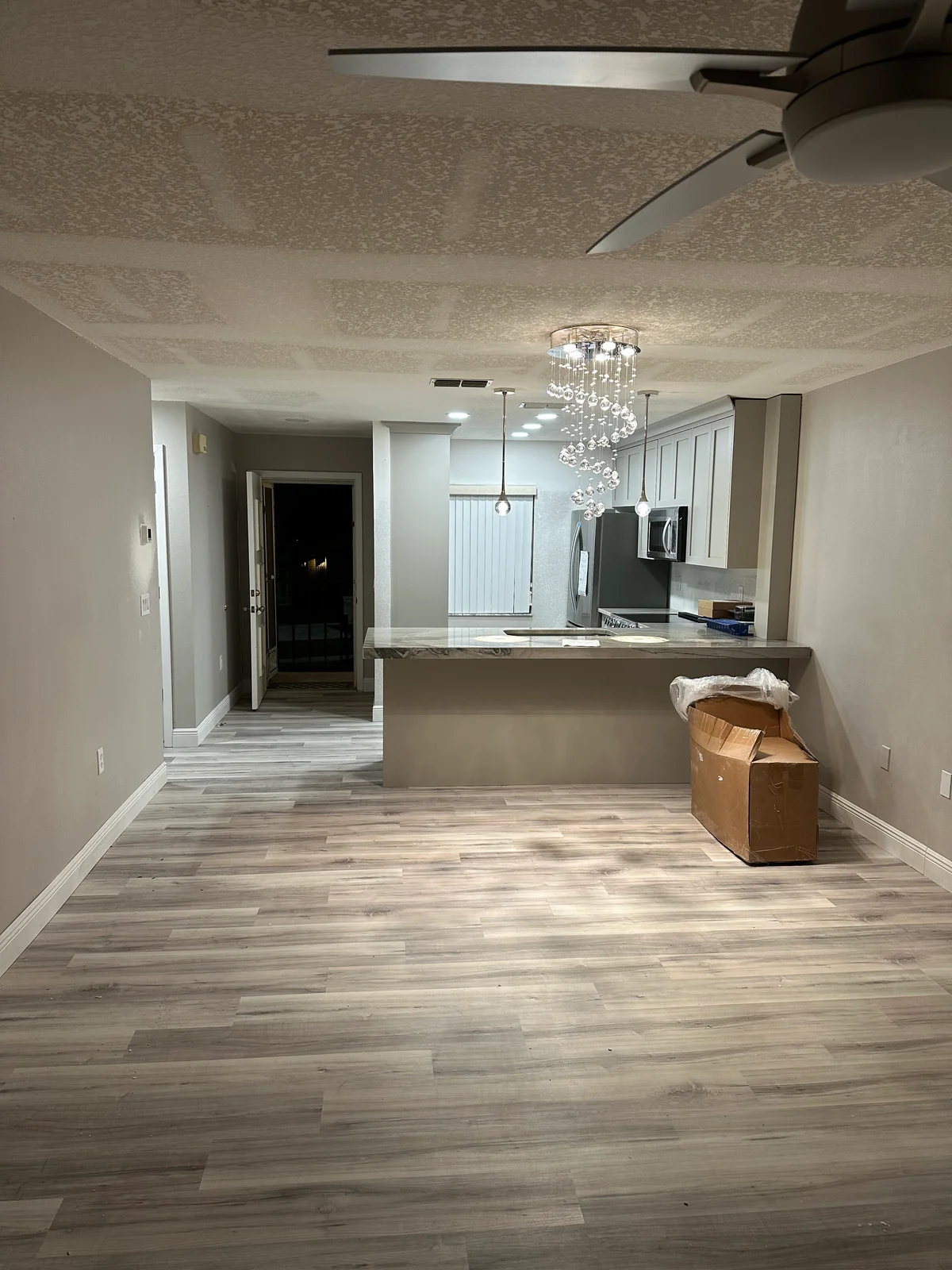
They look alike on a showroom wall, but they are not the same floor. Vinyl plank has a plastic core. Laminate is a printed picture of wood on top of a wood fiber board. That one difference decides most of the rest, and it matters most in any room where water can reach the floor.
We sell and install both from our showroom in Odessa, through our luxury vinyl plank and laminate flooring work, so we are not neutral. Where a fact comes from a maker or a magazine, the link takes you to the page we read. We left prices out, because they depend on your room and the product you pick.
Two floors that look alike and are built differently
MSI, a company that makes both, describes laminate as a core of wood byproducts mixed with resins. It has four layers: a wear layer, a printed wood design, a fiberboard base and a rigid backing. Bob Vila agrees that the core is high density fiberboard, and calls it the thickest layer.
Vinyl plank has a layer count that looks similar and a core that is not. MSI says the core is multi-layer PVC, topped with a wear layer and a print layer. MSI also names WPC and SPC cores as waterproof options. Those are the names you will see on a box when a plank has a harder or thicker core.
Here is how the two line up. The rest of this guide explains each row.
| Your question | Vinyl plank | Laminate |
|---|---|---|
| What is the core? | Plastic (PVC) | Wood fiber and resin |
| Water | The plank resists it | The core can swell or warp |
| How does it go down? | Click together, or glued | Click together, floating |
| Rooms the sources list | Wet and dry rooms | Mostly dry rooms |
If your question is “which floor is better,” the honest answer is “better where?” The rest of this post goes room by room, with the water question first, because water is where these floors part ways.
Water decides most rooms
MSI says laminate “can become damaged by water pretty easily,” and that some versions are water-resistant but not waterproof. It says vinyl has superior resistance to moisture. This Old House says the same in other words: traditional laminate can swell or warp with excess moisture, and does not stand up to moisture as well as vinyl.
Bob Vila adds a detail that matters in a real house. Moisture should not be left sitting on laminate, because excess water can cause warping or staining, and poor installation can let moisture in. It also quotes a flooring company executive who says laminate now comes in waterproof designs. So the word on the label counts. Read it, and read the care guide for that exact floor.
What a maker’s rules look like
Pergo, a laminate maker, gives a real number. Its international website says spills must be removed within 24 hours, or within 72 hours if the floor has a 15-year wet warranty. It says its AquaSafe coating stops water from penetrating the grooves.
That is one maker, on one line of floors. Other makers set other limits, so a number from one box does not carry over to another.
What the installation guide asks for
One laminate installation guide, posted by the flooring distributor R.A. Siegel, lists bathrooms, powder rooms, kitchens, mud rooms, foyers and laundry rooms as wet areas. To keep the residential water warranty, it asks for the gap around the edges of the floor to be filled with flexible silicone, so moisture does not reach the core of any cut plank. Take that as a sign of what the warranty expects of the install, not as a promise about your floor.
Our view: if a leak under the sink or behind the refrigerator worries you, vinyl plank gives you more room for error. Laminate can work in a dry kitchen, but then you are relying on the install and on wiping up spills.
“Waterproof” vinyl still has limits
A waterproof plank is not a waterproof floor. A Mohawk installation guide for one of its click vinyl planks says vinyl tiles resist water damage but do not prevent moisture from passing through. It asks you to keep moisture from collecting on either side of the floor, to prevent mold and mildew.
So both floors handle a spill. Neither is a sealed box. The real test is a slow leak, a wet slab or a pooled mess that sits for days, and on that test, laminate has less margin than vinyl plank.
What goes under the floor
This is the part the shelf tag skips. Many planks of both kinds float, which means they lock to each other and rest on the floor below. Both still need a good base.
Flatness
The two guides we opened set different limits. The Mohawk vinyl guide asks for a floor flat within 3/16 of an inch over a 10 foot radius, with high spots sanded and low spots filled. The laminate guide asks that any unevenness greater than 1/16 of an inch over 3 feet be smoothed out.
Those numbers come from one product each, and your product’s guide is the one to follow. The pattern is worth noticing, though: the laminate guide we read asks for a tighter floor.
Concrete and moisture
If your home sits on a concrete slab, this one matters. The Mohawk guide says moisture in a concrete slab should not exceed 5 pounds on a calcium chloride test, or 85% relative humidity on a probe test. It asks the installer to record the results for the owner, for warranty purposes. The laminate guide sets 5 pounds as well, and 80% on the probe test. It also calls for a moisture barrier of at least 6 mil poly over the slab if the underlayment does not have one attached.
Ask who tests your slab and what the result was. The Mohawk guide says its warranty does not cover problems caused by a bad substrate, and the shelf tag will not tell you that.
The old floor
Not every old floor can simply come up. The Mohawk guide warns that old resilient flooring and its adhesives may contain asbestos, and says to presume they do unless you are positively certain they do not. It says never to chip or pulverize them. Ask what is down now before anyone starts to demo it. We also take out old floors as part of the job.
How each one feels to walk on
Nobody we read measured comfort, so treat this part as opinion from the sources.
America’s Floor Source, a flooring retailer, calls vinyl plank softer, warmer and quieter underfoot, and says a quality underlayment helps soften laminate. This Old House says the opposite about comfort: it calls laminate comfortable on the feet because of its thick build. The same article says a floating laminate floor can sound hollow when walked on unless it has the right underlayment.
Bob Vila notes that laminate is noisier than hardwood, and that any hard surface floor is less quiet than carpet with an attached pad. It suggests soundproofing underlayment, and says a foam underlay adds to it.
So the sources split on comfort and agree on one thing: the layer under the floor changes how it sounds. If sound matters in your house, ask about the underlayment before you ask about the color.
Scratches, dents and repairs
Here the sources disagree, so be careful with anyone who gives you a firm ranking.
America’s Floor Source says laminate offers exceptional resistance to scratches and fading, and says vinyl plank is more susceptible than laminate to dents under heavy furniture and to surface scratches. This Old House calls vinyl highly resistant to scratches, dents and stains, and then lists denting from heavy furniture among its drawbacks. It says laminate is more scratch-resistant than any wood floor, but that once it is scratched, the damage is permanent and cannot be sanded out.
Bob Vila adds that laminate eventually wears out and cannot be refinished, but a damaged plank can often be replaced on its own. Ask your installer how a single plank would be replaced in the floor you pick.
Whichever you choose, keep the leftovers. The Mohawk guide says to store extra flooring flat in a climate controlled area for repairs, and to buy five percent more than you need for cuts, and ten percent more for a diagonal layout.
Putting the floor down
MSI says laminate uses a click-lock system with no glue. Vinyl can be click-lock or glue-down, and glue-down products need a separate adhesive. A floating floor still has rules.
Both guides ask you to let the planks sit in the room for 48 hours before install. The laminate guide wants a gap of at least 3/8 of an inch around the edges, so the floor can expand and contract with the seasons. The Mohawk guide asks for about 1/4 of an inch. The laminate guide asks for the room to stay at 60 to 85 degrees and 35 to 65% humidity. The Mohawk guide asks for 65 to 85 degrees, and humidity below 65%.
The laminate guide says the floor needs room to expand and contract, and that the trim is fixed to the subfloor, never to the floor itself. Ask where the gaps will be and how they get covered.
Room by room
Sources do not agree on every room, so this table shows what each one says, and the lines after it show where we land.
| Room | Vinyl plank | Laminate |
|---|---|---|
| Bathroom | Listed by This Old House | Advised against by MSI; left off the This Old House list |
| Laundry or mudroom | Recommended by This Old House | Advised against by MSI |
| Kitchen | Listed by both | Listed by This Old House; “possibly unsuitable” per MSI |
| Living room and dining room | MSI says every room | Recommended by MSI |
| Entry | MSI says every room | Recommended by MSI; the install guide above calls a foyer a wet area |
The kitchen is the room with the most disagreement. A dishwasher, a refrigerator with an ice maker and a sink are three places for water to come from, so we weigh that room hardest. In a living room or dining room, where water rarely shows up, both floors are a reasonable bet, and the choice comes down to how you feel about the look and the sound.
How to choose
Vinyl plank fits if
Water can reach the floor: a kitchen, a bathroom, a laundry room or a mudroom. It also fits if you want a floor that handles a wet day with less worry. Read the care guide for the exact plank, because a waterproof plank still needs a flat, dry base. See our luxury vinyl plank page.
Laminate fits if
The room stays dry, like a living room or dining room, and you want a hard surface. It also fits if you will wipe up spills quickly and want the install done to the maker's water rules. See our laminate flooring page.
What to ask before you buy
- Which room is this for, and can water ever reach this floor?
- If it is laminate, what is the maker’s water rule, and how long do I have to wipe up a spill?
- Who tests my slab for moisture, and what does the maker’s limit say?
- How flat does my floor need to be, and what happens if it is not?
- Where do the expansion gaps go, and how will they be covered?
- What underlayment do you suggest, and what does it do for sound?
- What is under the old floor, and who takes it out?
- If one plank gets damaged, how would you replace it?
Torn between vinyl plank and laminate? Tell us which room and we can talk it through.
Where we work
We install both floors from our base in Odessa, in Pasco County, and we work across Pasco, Pinellas and Hillsborough. Tell us which room you want to change, and whether water ever reaches that floor.
About the author
Andy's crew installs both of these floors. Andy Tsiouklas is the owner of Trinity Tile and Stone. In Andy's words: "My father has been in the construction field all his life, and I ended up going the same route he did, keeping it in the family."
Related work
We install both floors, and each has its own page.