
LVP Over Tile: Laying a New Floor Over the Old One
Can a new floor go over old tile? What the makers say about flat floors, grout lines and door height, and when the tile should come out.
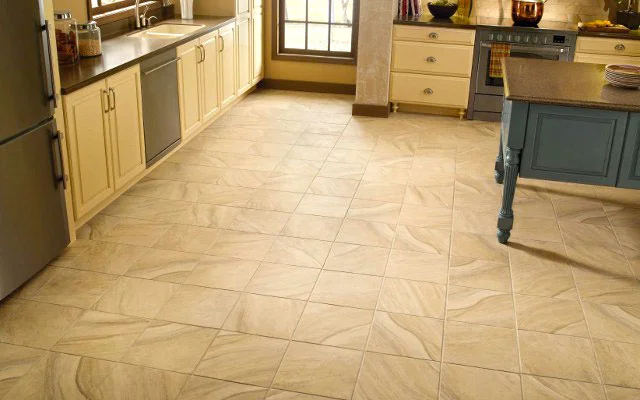
Often, yes. Several flooring makers say a floating vinyl or laminate floor can go over old ceramic tile, if the tile is solid, the floor is flat enough, and the grout lines are filled. When one of those fails, the tile is better out.
We install luxury vinyl plank and we pull up old tile when it has to go, so we gain either way. That is why each point below names its maker or association, so you can read the page yourself. We left prices out, because they depend on your floor.
The short answer: sound tile can stay
A floating floor is one where the planks lock to each other and rest on the floor below, with no glue. The old tile becomes the base.
Mohawk’s installation guide for its 4 mm click vinyl plank lists prepared ceramic tile among the bases it accepts. The word “prepared” matters, and we will get to what it means. COREtec’s floating installation instructions, from its maker USFloors, say the planks can go over most existing hard surface floors if the floor is clean, flat, dry and structurally sound. For ceramic tile, they add that it must be stuck down firmly, in good condition, clean and level.
Laminate follows the same logic. Swiss Krono, a laminate maker, says on its guide to what you can install laminate over that ceramic tile is fine if the floor is flat and level, that the tiles must be smooth, and that padding is a must.
Read those three together and the same few words keep coming back: stuck down, flat, smooth, clean. The old floor has to earn its place under the new one.
Is the old tile still stuck down?
Start here, because nothing else matters if the tile is loose.
Walk the room. Look for tiles that rock, sound hollow, or have cracks running through them. Swiss Krono says to check for cracked or loose tiles and grout, and says those can be signs of a poor floor caused by settling. If the floor under your tile has moved once, it can move again, and it will take the new floor with it.
Mohawk is just as clear that this carries through. Its guide says that if a subfloor has too much vertical movement before the flooring goes in, it will likely keep moving after. Its fix for the tile itself is plain: remove any loose tiles and fill the holes with a Portland cement floor fill.
So here is the line we would draw. One loose tile by a doorway is a repair. Loose or cracked tile all over a room means the old floor is failing, and a new floor on top inherits that. If you are not sure which one you have, our guide to why floor tile cracks explains what the cracks are telling you.
Flat enough? Two sets of numbers do not match
This is where the most homes run into trouble, and it is easy to miss by eye.
Plank makers ask a lot of the floor. Mohawk wants it flat to within 3/16 of an inch over 10 feet, or 1/8 of an inch over 6 feet. COREtec asks for 3/16 of an inch over 10 feet. The National Wood Flooring Association, the trade group for wood floors, uses the same two numbers for floating wood floors, unless the maker of the wood says otherwise. It also says only engineered wood can be floated, and that a floating wood floor should not go on a surface that is not flat.
Now look at the tile side. The Ceramic Tile Foundation quotes the tile standard, ANSI A108.02. For tiles with every edge under 15 inches, it allows a floor to vary by up to 1/4 of an inch over 10 feet. Tiles with an edge of 15 inches or more get a tighter limit, 1/8 of an inch over 10 feet.
That means a floor built to the first limit can be wavier than a plank maker will accept. A quarter inch is more than 3/16. The old tile was likely fine for tile. It may still need work for a plank.
How to find out
Lay a long straightedge on the floor and slide a tape measure under it. Look at the gap in the middle and at each end, and try it in a few spots and in more than one direction.
What fixes it
Both makers name the same repair. Mohawk says to sand down high areas and fill low ones with a Portland cement compound that is rated for at least 3,000 psi. COREtec says to grind down high spots and level low ones with a Portland based leveling compound.
One thing not to do: use tile mortar as a leveler. The Ceramic Tile Foundation says thin-set and the heavy mortars used for large tile are not designed to repair surface irregularities.
The grout lines are the part people forget
Grout sits lower than the tile. On a floating plank, that low line has nothing under it.
Mohawk’s guide handles it directly. For ceramic tile, it says to roughen the surface, then fill the grout joints flush with the tile surface using a Portland cement floor fill, following the fill maker’s directions. It does not give a width below which you can skip this step.
The lesson is that the rule depends on the maker. Mohawk says fill the joints, and another maker may set a width below which you can skip it. Ask which guide your plank comes with, and hold the installer to that one.
Texture counts too. Swiss Krono says the tiles must be smooth. A stone look tile with a deep, rough face is a harder base than a flat porcelain one. Our reading is that the deeper the grooves in the tile, the more there is to fill.
Doors, edges and how much the floor rises
A new floor sits on top of the old one, so the room gets higher. Mohawk’s plank in the guide above is 4 mm thick. Add any pad or patch your plank calls for, and the rise is more than that.
Two parts of the COREtec instructions deal with this. First, they say to undercut all door jambs, so the plank can slide beneath them. A door that swings over the new floor may need a trim at the bottom as well. Second, they say not to fasten wall moldings or transition strips to the planks, because a floating floor has to move a little. Where it meets another floor, the strip should be set so it does not pin the planks down.
The same instructions say not to put cabinets or fixed objects on top of the floor, and they call for room at the edges. In a kitchen, that means the plank stops at the cabinets and not under them.
Height is also the first question when the new floor is tile. The Tile Council of North America, the group behind the industry’s tile handbook, says tile over tile is common where there is no limit on floor height or wall thickness, and where the old tile is stuck down firmly. Tile and mortar both add height, so measure the door gaps and thresholds before you plan anything.
What about the slab?
Tile on top of a slab does not change what the slab is doing, and both guides care about that.
Mohawk’s guide says concrete must be fully cured and dry. It sets limits of 5 pounds on the calcium chloride test, or 85 percent relative humidity on the in-slab test. COREtec’s instructions list the same two numbers. Mohawk also reminds you that vinyl resists water damage but does not stop moisture from passing through it. It asks the installer to give the owner the recorded test results, for the warranty.
Those tests are done on the concrete. If your tile sits on a slab, the slab is what is being tested. Ask how that will be checked before a floor goes over it.
And new tile over old tile?
It can be done. The Tile Council says certain steps are needed for a good bond, and points to two handbook methods, TR712 and TR713. It also warns that not every thin-set, even the polymer modified kind, bonds directly to tile.
It says a bond test usually shows whether the old tile needs to be abraded first. It also warns that abrading tile can release fine particles that can harm you if you breathe them in, so the work needs the right safety gear.
If you want new tile and not plank, our tile installation page covers what we set. Tile on tile adds more height than a plank does, so it is the choice most likely to run into the door and threshold problems above.
Going over it, or taking it up?
Here is the whole thing in one place.
Going over it can work when
The tile is stuck down firmly, with only a few loose or cracked pieces. The floor checks out within your maker's flatness limit, or can be brought there with patching. The grout lines are filled or narrow enough for your plank's guide. The doors and thresholds have room. And the guide for the plank you chose says tile under it is allowed. Then luxury vinyl plank can float over the top.
Take it up when
Loose or cracked tile shows up across the room. The floor moves when you walk on it. The surface is too uneven or too rough to smooth out. Or there is no room for the new floor at the doors. Our own crew handles floor removal, then lays the new floor, so nobody hands the job off in the middle.
If your tile sits in the middle, tell us. A floor that is mostly sound with a bad patch near the sink is a different job from one that is sound everywhere. A quick look at the room tells you which one you have.
What to ask before anyone covers your tile
- Which installation guide comes with this plank, and does it allow tile under it?
- How will you measure flatness, and what will you do where the floor falls outside it?
- How will you handle the grout lines, and how wide are mine?
- How much will the floor rise, and which doors will need trimming?
- How will the slab moisture be checked, and will I get the results?
- What happens if loose tiles show up once the work starts?
A good answer names the guide and the number. A vague answer, like “we always do it this way,” is a reason to ask again.
Old tile and a new floor in mind? Tell us about the room and what is down now.
Where we work
We work out of Odessa, in Pasco County, and take floor work across Pasco, Pinellas and Hillsborough. Tell us about the room, the tile that is down now, and the floor you want on top.
About the author
Andy's crew takes out old tile and installs vinyl plank. Andy Tsiouklas is the owner of Trinity Tile and Stone. In Andy's words: "My father has been in the construction field all his life, and I ended up going the same route he did, keeping it in the family."
Related work
Vinyl plank, tile and floor removal are all on our list, and each has its own page.