
Tile Installation Cost: What a Quote Should Include
What moves the price of a tile floor, and what a quote on paper should list: the old floor, the prep, the tile, the extra tile, the trim and the haul away.
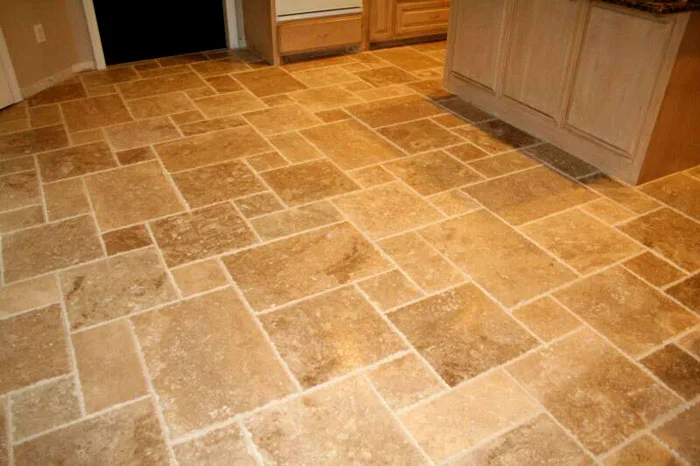
Nobody can name what your tile floor will cost without seeing the room, and a page that does is guessing. What you can know before you call is what moves the price and what a quote on paper has to spell out. This guide covers both. We left every dollar figure out on purpose, because a national average says nothing about your floor, your old tile or your layout.
The better tool is a short list of questions. Ask them of every contractor who bids, including us.
One number is not a quote
The Federal Trade Commission says an estimate on paper should include a description of the work, the materials, the completion date and the price. It also says not to pick the lowest bidder automatically, and to ask for an explanation when the estimates differ a lot.
Use that second piece of advice. When two tile quotes sit far apart, the lower one often counts less work, not less money. One may include taking up the old floor and the other may not. One may include fixing the surface under the tile and the other may assume it is fine. You cannot tell from a single total.
Here is what a tile floor quote should list, each on its own line:
- The old floor: what comes out, and who hauls it away.
- The surface under it: how it is checked, and what is done to it.
- The tile: what it is, how much, and how much extra is counted.
- The layout: straight, diagonal or a pattern.
- The edges: every doorway and every place the tile meets another floor.
- What happens if something shows up once the old floor is open.
Each one has a section below. We do both the tile setting and the old floor removal, so we are not a neutral party. Ask us the same questions.
What comes out, and what is under it
The old floor is its own line. Taking old tile up is noisy, heavy work, and the quote should say who does it. Floor removal is a job we do with our own crew, so you can ask us about it along with the new tile.
Sometimes the old floor does not have to come out at all. The Tile Council of North America says you can tile over some floors, but the whole structure under the tile matters, and that means more than the top layer. It says wax on old vinyl and leftover carpet adhesive can stop the bond, and that they have to be dealt with first. TileLetter, a trade magazine for tile installers, says existing tile can stay when it is stuck down firmly, clean and flat, and that tapping the surface can point to areas worth a closer look, though it warns that a change in sound alone does not prove the tile has let go.
So ask a plain question: is my old floor coming out, or staying under? Then ask why. A good answer points to what the contractor found, not to what is cheaper for them.
Then there is the question nobody wants to ask. Some old flooring can contain asbestos, in the tile or in its backing. The Environmental Protection Agency says not to sand or try to level asbestos flooring or its backing. It also says that if a remodel means removing it, only a trained, accredited professional should do that. TCNA says its tile-over guidance does not apply to asbestos-based resilient tile.
We are not saying your floor has any. We are saying the quote should say what happens if it does, before the work starts and not in the middle of it.
Prep is the line to read twice
Tile is rigid. It cannot follow a floor that is wavy or one that bounces, so the surface under it gets checked first. This is the part a homeowner cannot see from above, and it is where one quote often says more than another.
Start with flatness. TileLetter reports that the industry standard, ANSI A108.02, allows the floor to vary by a quarter inch over ten feet when every tile edge is under 15 inches. When a tile has an edge of 15 inches or longer, the limit drops to an eighth of an inch over ten feet. So a larger tile asks more of the floor. Low spots are found with a ten foot straightedge or a laser. Construction Canada says a self-leveling underlayment is the easiest way to get a floor flat enough. That is an extra material and an extra step, and it belongs on the quote as its own line when your floor needs it.
Old glue and paint matter too. TileLetter says old thinset gets ground off or covered with a patch. It also says paint should not come off with solvents or strippers, and that you should never use acid to prep a concrete floor, because leftover acid crystals can attack the mortar later.
Then there is movement. TileLetter says the TCNA Handbook caps framed floor deflection for ceramic and porcelain tile at L/360, where L is the clear span of the supporting framing. Its article on substrate prep says natural stone gets a stricter limit. When a floor looks too springy, TileLetter’s advice is to ask an architect or engineer to calculate the movement. If a contractor says “it will be fine” and nothing more, ask how they know.
The same Construction Canada article says a cracked floor needs a crack isolation membrane, that control joints are needed, and that expansion joints should carry through the finished surface instead of being covered over. Ask where the joints will fall.
How the room gets measured
Measuring a tile floor is more than length times width. This is what a measurement should count, and each item can move the price.
How the room gets measured
- The floor in every room, including closets and alcoves, because each corner is more cuts.
- The pattern. Diagonal and intricate layouts can need more tile than a straight grid.
- The tile size. The flatness limit gets tighter for tiles with an edge of 15 inches or longer.
- The low spots, found with a ten foot straightedge or a laser, and what each one needs.
- The old floor coming out, and what it is. See floor removal.
- Every doorway and edge where the tile stops, so the trim fits the tile's thickness.
- The area the new tile covers. See tile installation.
Of everything on that list, the extra tile is the one homeowners are least ready for. Cuts at the walls leave pieces you cannot use, and some tile breaks in handling. Belk Tile, an online tile retailer, names cutting and installation waste as the main reasons to buy extra. It says diagonal or intricate patterns may need even more than the usual allowance, and that larger tiles can create more waste because they take more careful cutting. It also suggests keeping a few spare full tiles somewhere cool and dry, in case one chips later.
We could not open a tile maker or standards page that gives a number for this, so we are not printing one. The honest version is that the extra depends on the room, the layout and the tile. Ask what allowance is in the count, and ask that it be written down. If you want a layout that cuts a lot, such as a diagonal or a pattern, ask that the quote says so, because it changes how much tile gets bought.
The tile you pick is the one line you choose yourself. If you are weighing options, our guide to ceramic or porcelain tile explains how they differ.
Edges and trim
Where the tile ends is easy to overlook until it is done. A doorway to a hallway, a step down to concrete, the line where tile meets wood: each one needs a plan, and each plan is a part you buy.
Schluter, which makes tile trim, describes its RENO-U profile as a way to protect the tile edge and make a smooth transition to a lower floor covering. It is set in the mortar under the tile. Schluter says to pick the size by tile thickness and format, and, if you use one of its uncoupling membranes, to add that thickness into the choice. So trim is not an afterthought. It is picked once the tile is picked.
Ask the contractor to count the edges and name how each one will finish. A quote that says nothing about trim usually means it will be decided later, and later is when a change order shows up.
Questions to ask every contractor
You now have most of the list. Here it is in one place. Bring it to each bid, and put the same questions to every one.
- Is the old floor coming out, and who does that?
- Who hauls the old floor away?
- How is my floor checked for flat and solid, and who decides?
- If my floor needs leveling or a crack membrane, is that on the quote?
- What happens if the old floor or its glue could hold asbestos?
- What allowance for extra tile is in the count?
- How is each edge and doorway finished?
- Where do the joints go?
- What is the plan if the floor under the old tile is not what we expected?
A contractor who answers these without hurrying is one you can compare. A contractor who cannot answer them has given you a number and not a quote.
If you are still choosing tile, our showroom in Odessa is the place to see it in person. Either way, we give free estimates, and we will go through this list with you.
Want to know what your tile floor quote should list? Call us, or ask for a free estimate.
Where we work
We work out of Odessa, in Pasco County, and take tile jobs across Pasco, Pinellas and Hillsborough. Tell us about the room and the old floor, and we will tell you what we would write down.
About the author
Andy's own crew sets tile and takes up old floors. Andy Tsiouklas is the owner of Trinity Tile and Stone. In Andy's words: "My father has been in the construction field all his life, and I ended up going the same route he did, keeping it in the family."
Related work
These are the two jobs a tile floor quote is built from.