
Lanai Flooring: What Works on a Florida Lanai or Porch
What holds up on a lanai or porch: outdoor rated porcelain tile, pavers and stone, and the slip number to ask for, with tile council and maker sources.
A good lanai floor does three things. It grips when it is wet, it drains, and it is built for the outdoors from the tile down to the slab. Most lanai floors that go wrong miss one of those, not the look.
The short answer to “what is the best flooring for a lanai” is a floor rated for outdoor use by its maker, with a wet slip number meant for outdoor areas. In practice that usually means outdoor rated porcelain tile, pavers or natural stone.
We install tile, stone and pavers, so we are not a neutral party. We kept every claim below to what the Tile Council of North America (TCNA), tile makers and the paver industry’s own association say, and we link each one so you can read it yourself.
What makes a lanai different from a room
A lanai or porch sits between the house and the yard. Even under a roof and a screen, rain can blow in, pool water gets tracked across it, and the sun reaches part of the floor for part of the day. Whether that happens on your lanai depends on the roof, the screen and which way it faces. Plan for the wettest corner, not the driest.
TCNA’s page on tiling exteriors is blunt about this. It says methods developed for interior installations are not necessarily right for exterior ones, and that forces acting on the tile outside can be much greater than on a comparable interior job. It lists what has to change:
- The tile must be rated by its maker for exterior use.
- The setting materials and the surface under the tile must suit outdoor conditions.
- The installation must drain water before it can soak into the tile or the layers under it.
- Expansion joints must be designed in, to allow for movement from large temperature swings and water.
For a concrete slab outdoors, the same page says it is typically important to have better than 95% mortar contact between the tile and the slab, with mortar rated for exterior use, and grout joints that are full, compacted and preferably sealed with a sealer that lets vapor pass.
That is the real difference. A lanai floor is less about picking a tile and more about picking an outdoor system.
The slip number to ask for
If you shop for outdoor tile, you will see a number called DCOF. It stands for dynamic coefficient of friction, a lab measure of how well a surface grips. TCNA explains the test, ANSI A326.3, on its DCOF page.
Most people have heard of 0.42. That is the wrong number for a lanai. Crossville, a porcelain maker, says on its DCOF ratings page that 0.42 wet is the industry standard for level interior spaces expected to be walked on when wet. It lists home kitchens and baths there.
For outdoors there is a separate category. Crossville calls it Exterior Wet. It says tiles in that class typically have a higher wet DCOF and a more textured surface for traction, and may suit level outdoor areas that may be walked on when wet, such as patios, walkways and pool decks.
Marazzi, another tile maker, puts a number on it. Its industry standards page shows Exterior Wet as a wet DCOF of 0.60 or more, for areas such as walkways, gazebos and patios. Ramps and inclines are higher again, at 0.65 or more.
So ask for three things on any tile you are shown for a lanai:
- Is it rated by the maker for exterior floors?
- What is its wet DCOF, for this exact tile and finish?
- Which ANSI A326.3 category does the maker put it in?
A good number is not a promise
Marazzi says it plainly: “No floor tile is “slip proof.”” Its page says slippery conditions are reduced by drainage, cleaning up spills quickly, the right footwear and proper maintenance. Crossville adds that its categories are general and should not be the only thing you rely on when choosing a tile.
Two more points from Marazzi matter on a lanai. It does not recommend polished or semi polished tile anywhere that may get wet. And it says ceramic and porcelain tile should not be used where water sits on the floor all the time, which includes outdoor areas. That is why drainage comes before the tile.
If slips are the worry behind your question, our guide to safer floors for older homeowners goes further into grip, rugs and thresholds.
Outdoor porcelain tile
Porcelain is the tile most people mean when they say outdoor tile. Consumer Reports’ flooring buying guide says ceramic and porcelain resist moisture. The difference between the two is in how dense they are, which our guide to ceramic or porcelain tile explains.
Being porcelain is not enough by itself. TCNA’s exteriors page says the maker has to rate the tile for exterior use, and that makers look at more than the standard tests when they do. So check the rating for the tile you like, not the line it belongs to.
Bigger is not always better outside
Large tiles look clean on a lanai, but Marazzi notes a trade off. Smaller tiles allow more drainage through more grout joints and are easier to slope. Slight unevenness across a larger tile can leave more standing water.
That does not rule out large tile on a lanai. It means the slope and flatness of the slab matter more, and it is worth asking how water will leave the floor before you fall for a size.
Movement joints
Tile and the slab under it grow and shrink at different rates. TCNA’s page on movement joints says they are placed more often where moisture or direct sunlight is expected, and that outdoors the range from summer highs to winter lows has to be considered. A lanai gets both. Expect to see soft joints in a lanai floor, and ask where they will go.
If you want tile on your lanai, our tile installation page explains how we work.
Pavers
Pavers are separate units set on a compacted base, with joints between them. One useful trait follows from that: a paver that sinks can be lifted and set again, as the next source explains.
The paver industry’s own trade group, the Concrete Masonry and Hardscapes Association (CMHA), explains what goes wrong in its guide to paver depressions. It says dips are caused by settlement of the soil or gravel base under the pavers, often from a base that was not compacted well enough. For a low dip, it says the pavers can be removed, the settlement adjusted, and the units put back.
That points to the question to ask about pavers. It is less about the paver and more about the base: what goes under them, how deep, and how it is compacted.
Pavers can also go where a lanai or patio meets the yard or the pool, so the two spaces match. Our pavers page says more about the paver work we do.
Natural stone
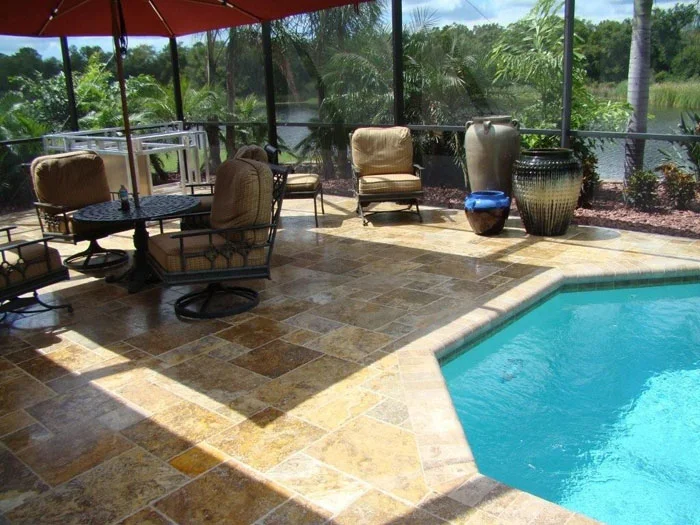
The photo at the top of this page shows stone tile beside a screened pool. Stone has the same outdoor rules as tile: the maker or supplier should say it suits exterior floors, the finish should not be polished, and the system under it must drain and allow for movement.
The finish matters as much as the stone. Bob Vila’s guide to travertine says polished travertine is slippery when wet. It says honed travertine, which is filled and sanded smooth, also works outdoors, and that tumbled travertine has the most rustic look. That matches the tile makers: a shiny finish and a wet floor do not mix.
Ask the supplier which finish and thickness they sell for outdoor floors, and whether the stone needs sealing. Our travertine page covers travertine floors inside the house. If you are weighing stone for the lanai, ask us when you call.
Good fits and poor fits
Here is the summary, drawn from the sources above.
Good fits for a lanai
- Porcelain tile the maker rates for exterior floors, with a wet DCOF in its outdoor category (Marazzi: 0.60 or more).
- Textured or matte finishes, which the makers tie to better traction outdoors (Crossville).
- Pavers on a well compacted base (CMHA).
- Stone with a finish the supplier says suits outdoor floors.
Poor fits
- Polished or semi polished tile anywhere it may get wet (Marazzi).
- A tile chosen only because it meets 0.42, the interior number (Crossville).
- Any floor where water sits on the surface all the time (Marazzi).
- Indoor setting materials and indoor methods (TCNA).
What to ask before you start
Bring these to anyone who quotes your lanai, us included:
- Is the tile, stone or paver rated for outdoor floors, and what is its wet DCOF?
- Which way does the slab slope now, and where will water go?
- Is the mortar or base rated for outdoor use?
- Where will the movement joints be?
- For pavers, how deep is the base, and how is it compacted?
- How should the floor be cleaned, so it keeps its grip?
A floor that answers all six well will look good for a long time. A floor picked only from a sample board may look good on day one and slip on the first wet morning.
Thinking about a new lanai or porch floor? Tell us what is out there now.
Where we work
We work from Odessa, in Pasco County, and take on tile, stone and paver jobs across Pasco, Pinellas and Hillsborough. Tell us how your lanai is covered and what the floor sits on.
About the author
Andy's own crew sets tile, stone and pavers. Andy Tsiouklas is the owner of Trinity Tile and Stone. In Andy's words: "My father has been in the construction field all his life, and I ended up going the same route he did, keeping it in the family."
Related work
These are the jobs a lanai or porch floor usually comes down to: tile, pavers or stone.